Program
We’re excited to bring you an engaging program filled with insightful talks, interactive sessions, and opportunities to connect with leading experts in the field.
Program Overview
Click here for the detailed program.
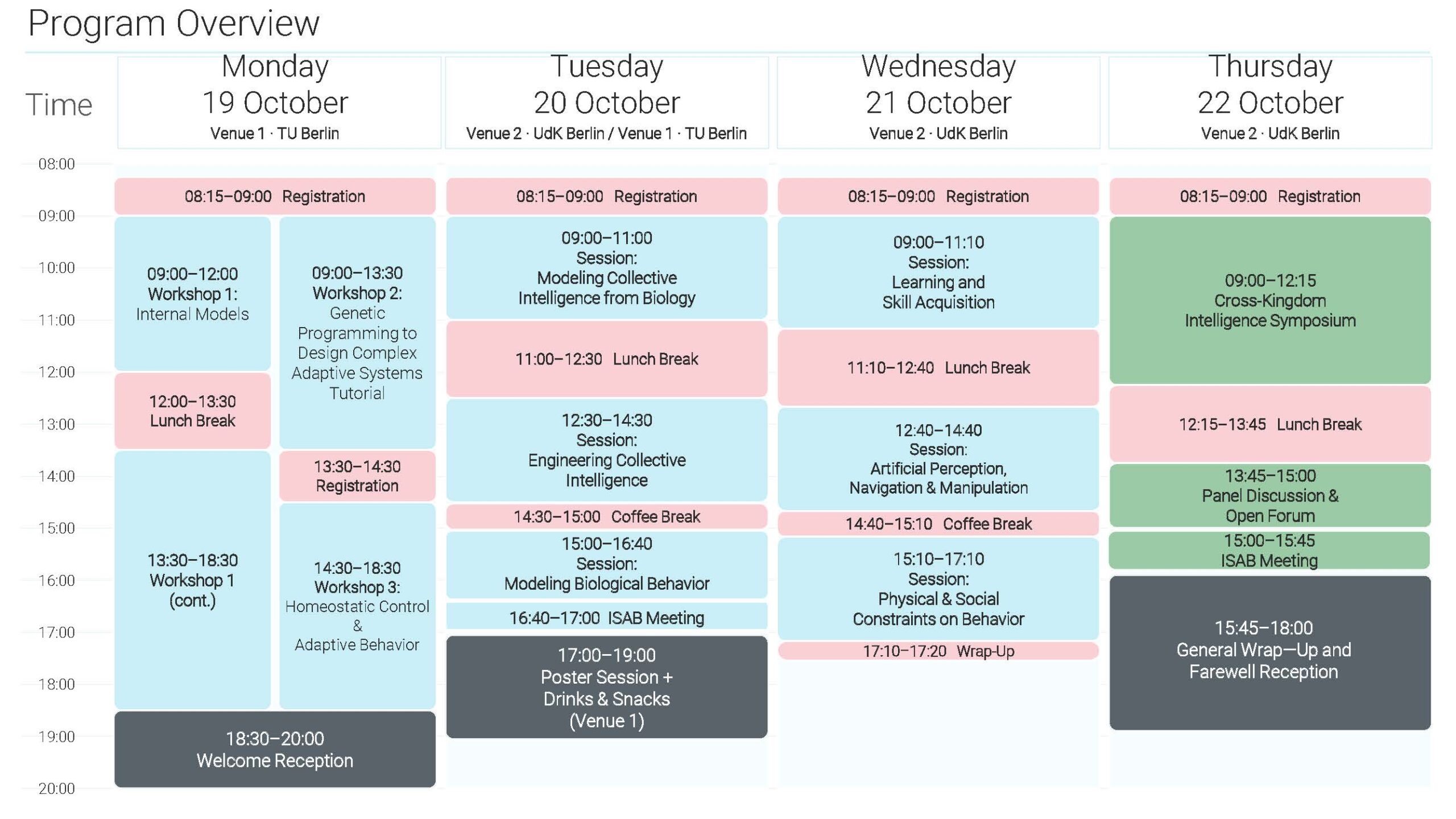


We’re excited to bring you an engaging program filled with insightful talks, interactive sessions, and opportunities to connect with leading experts in the field.
Click here for the detailed program.
On 22 October 2026, the Cross-Kingdom Intelligence Symposium will take place as part of SAB 2026 in Berlin, bringing together perspectives on intelligence across animals, plants, fungi, and artificial systems.
Find out more about the symposium →
Date and Time: October 19th 2026, 9:00am to 6:30pm CEST
Webpage
Natural and artificial systems build internal models of the world to predict, plan, and adapt their behavior. The session brings together perspectives from neuroscience, cognitive science, robotics, and machine learning to compare related ideas such as predictive coding, mental simulation, internal models, and world models. Through invited talks, cross-field questions, and a closing panel, participants will work toward a shared vocabulary and a deeper dialogue between biological and artificial intelligence research.
Date and Time: October 19th 2026, 9:00am to 1:30pm CEST
Webpage
Genetic programming provides a scalable and interpretable approach to designing agent-based models of complex adaptive systems through symbolic regression. The tutorial introduces participants to JAX-based tools for discovering mathematical rules that govern agent behavior and integrating them into efficient simulations. Through hands-on examples, participants will learn how to build, optimize, and evaluate interpretable agent-based models using modern genetic programming frameworks.
Date and Time: October 19th 2026, 2:30pm to 6:30pm CEST
Webpage
Adaptive behavior depends not only on external rewards but also on the regulation of internal physiological needs that drive motivation and decision-making. The session brings together perspectives from neuroscience, biology, robotics, artificial intelligence, machine learning, and control theory to examine how homeostasis and internal state regulation shape behavior in both natural and artificial systems. Through invited talks, lightning presentations, a poster session, and a panel discussion, participants will explore interdisciplinary approaches to understanding and modeling motivated behavior.
The Poster session will take place on Tuesday, 20 October from 5-7pm at MAR Foyer, Ground Floor (Marchstraße 23, 10587 Berlin). The Poster Session will be divided in two parts, after 1 hour, the posters will be exchanged for the second group.
Please find all poster abstracts here:
(Password protected: registered attendees receive the password via the organizers.)
#9 Understanding the limits of collective intelligence in wild animal groups
Korbinian Pacher, Jens Krause
#13 “Liking” as Affective Feedback in Behavioral Control
Paul-Gunther Diestel, Lorenz Gygax
#19 Visual-based Collective Shepherding in Swarm Robotics
Yating Zheng, Haowei Ji, Heiko Hamann, Pawel Romanczuk
#22 Social context and temperature increase learning rate and decision consistency in a freshwater fish
Daphne Cortese, Amelia Munson, Aurelio Cortese, Nick Jones, Cheng Fu, Bowen Lii, Oluwaseun Ojelade, Shaun Killen
#30 A Drift-Diffusion Model of Behavioural Contagion in Human–Virtual Agent Interaction
Maryam Karimian, Asieh Daneshi, Fabio Reeh, Marcel Brass, Pawel Romanczuk
#33 Simulating mechanistic human-like eye movements for human-robot interaction
Ole Hall, Falk Young de Lacerda Tavares, Anna Eiserbeck, Julie Ouerfelli-Ethier, Runfeng Qu, Olaf Hellwich, Martin Rolfs, Klaus Obermayer
#34 Mechanical problem solving in mice
Sole Traverso, Marcus N. Boon, Niek Andresen, Sophia Meier, Friedrich Schuessler, Olaf Hellwich, Lars Lewejohann, Christa Thöne-Reineke, Henning Sprekeler, Katharina Hohlbaum
#36 The impact of deepfake labeling on the evaluation of emotional social scenes
Anna Eiserbeck, Martin Maier, Julia Baum, Rasha Abdel Rahman
#38 Dimensionality shapes collective escape dynamics: Comparing 2D and 3D models
Palina Bartashevich, Oliver Deussen, Lukas Erne
#40 From Individuals to Waves: Mechanisms Shaping Collective Responses in Sulphur Mollies
Bianca Pacini, Yunus Sevinchan, Korbinian Pacher, Jens Krause, Pawel Romanczuk
#42 Inferring Transmission Preferences in Language Model Agents: From Local Choices to Long-Run Cultural Dynamics
Dominik Pegler, Charley Wu, Danica Dillion, Tessa Verhoef, Sebastian Schuster
#43 A Computer Vision Approach to Analyzing Temporal Dynamics in Nonverbal Immediacy
Jonas Frenkel, Uros Petkovic
#45 Self-Organized Pattern Formation in Crossing Pedestrian Crowds
Sina Feldmann, Kyra Veprek, William H. Warren
#48 Visual Navigation at the Spatial-Social Interface
Patrick Govoni, Pawel Romanczuk
#49 Active Vision RL for Multiple-Object Tracking under Partial Observability
Miklos Kepes, Paul O’Dowd, Chanelle Lee
#52 Latent Representations Encoding Behavior and Modulating Adaptivity in Locomotion Learning
Janosch Bajorath, Malte Schilling
#58 Switching Dynamics of Belief and Movement in Social Learning
Ashwin Moongathottathil James, Eitan Hemed, Julia Magdalena Rodriguez Buritica, Marcel Brass, Verena Vanessa Hafner
#50 Speed-weighted social responses self-limit information cascades in fish shoals
Sara Neven, Andrew M. Hein, André M. de Roos, Benjamin T. Martin
(The contributor will attend but resigned from the official presentation/ still will be available for the discussion.)
Would you like to attend the SAB 2026 Conference?
