Animals, plants, and fungi differ radically in their physical organization, sensory capacities, and ways of interacting with the environment. Yet all must respond to changing conditions and coordinate processes in ways that support survival and adaptation. Artificial systems provide a further, fundamentally different point of comparison.
Could similar challenges give rise to mechanisms that share common organizational principles, despite being realized in entirely different biological or artificial substrates? Which similarities are deep, and which are only superficial? And do such comparisons justify speaking of intelligence across kingdoms and machines or do they reveal several distinct phenomena that should remain conceptually separate?
These questions also turn the comparison back onto artificial intelligence: What can biological systems teach us about the components and principles associated with intelligent behavior, and where might analogies between biological and artificial systems break down?
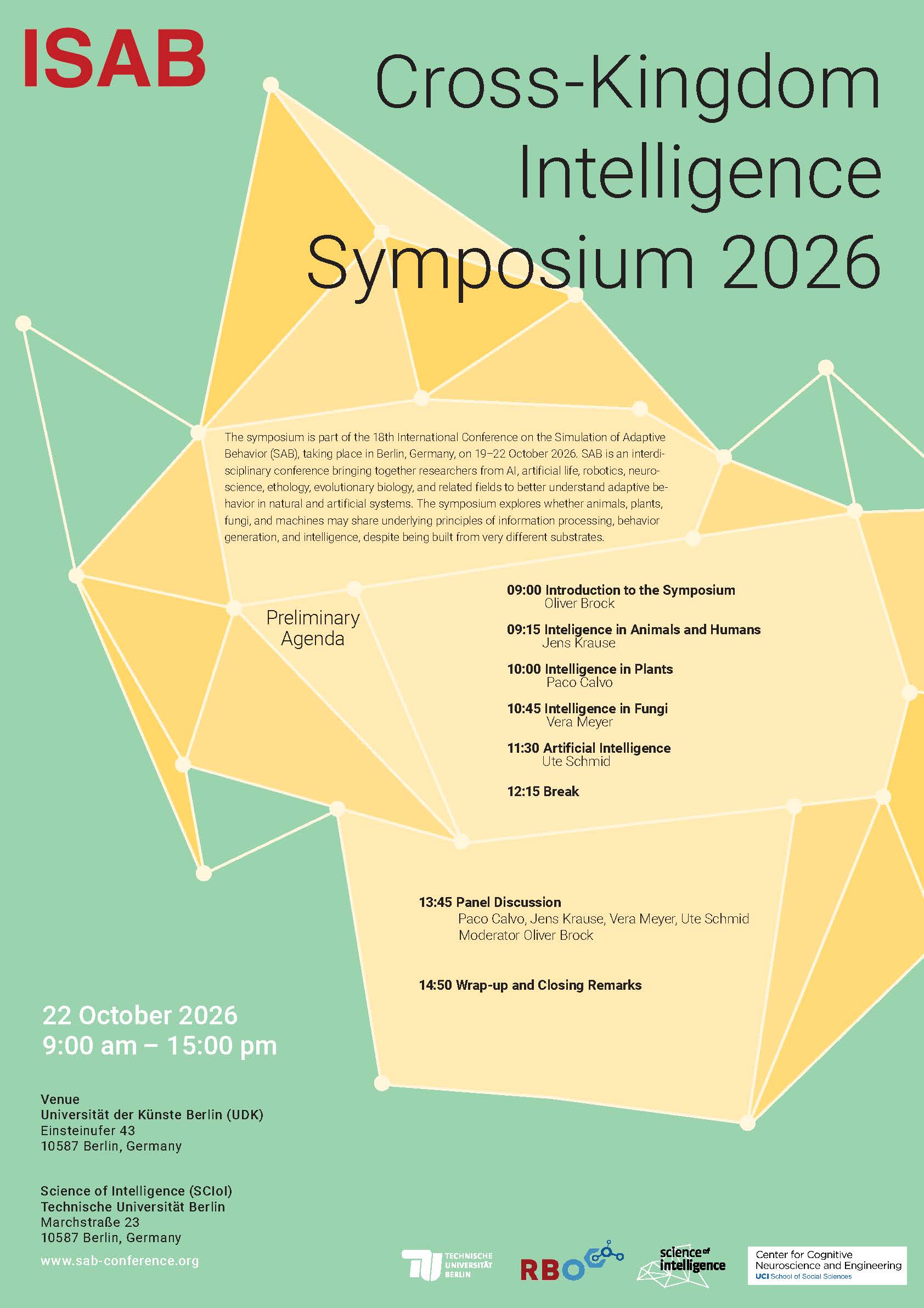
The symposium brings together expert perspectives from animal behavior, plant behavior and information processing, fungal biology, and artificial intelligence. Rather than presupposing a single definition, or even a single phenomenon, of intelligence, the session uses comparison across systems to ask which capacities and principles they genuinely share, where important differences lie, and what these comparisons can tell us about intelligence itself.
The presentations will be followed by a panel discussion and an open Q&A with the audience.